Nadir
Zishi Han, Laurence Sturla
Zishi Han, Laurence Sturla
“Myth makes Echo the subject of longing and desire. Physics makes Echo the subject of distance and design. Where emotion and reason are concerned, it's claims are accurate.
And where there is no Echo there is no description of space or love. There is only silence.”
Mark Z. Danielewski, House of Leaves
GIANNI MANHATTAN is pleased to present NADIR, a duo exhibition with Zishi Han (b.1990 in Beijing, lives and works in Frankfurt) and Laurence Sturla (b.1992 in Swindon, lives and works in Vienna).
The works of Zishi Han and Laurence Sturla negotiate a threshold where cartography becomes unstable and the joint presentation builds on the premise that reality (or an imagined reality) can be modelled in ways beyond merely communicating spatial information.
And where there is no Echo there is no description of space or love. There is only silence.”
Mark Z. Danielewski, House of Leaves
GIANNI MANHATTAN is pleased to present NADIR, a duo exhibition with Zishi Han (b.1990 in Beijing, lives and works in Frankfurt) and Laurence Sturla (b.1992 in Swindon, lives and works in Vienna).
The works of Zishi Han and Laurence Sturla negotiate a threshold where cartography becomes unstable and the joint presentation builds on the premise that reality (or an imagined reality) can be modelled in ways beyond merely communicating spatial information.
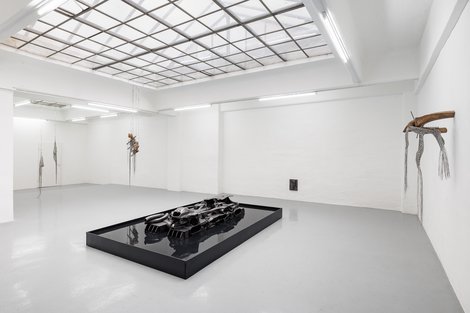
10.04.26—16.05.26
GIANNI MANHATTAN, Wassergasse 14, 1030 Vienna
> Installation views
“Myth makes Echo the subject of longing and desire. Physics makes Echo the subject of distance and design. Where emotion and reason are concerned, it's claims are accurate.
And where there is no Echo there is no description of space or love. There is only silence.”
Mark Z. Danielewski, House of Leaves
GIANNI MANHATTAN is pleased to present NADIR, a duo exhibition with Zishi Han (b.1990 in Beijing, lives and works in Frankfurt) and Laurence Sturla (b.1992 in Swindon, lives and works in Vienna).
The works of Zishi Han and Laurence Sturla negotiate a threshold where cartography becomes unstable and the joint presentation builds on the premise that reality (or an imagined reality) can be modelled in ways beyond merely communicating spatial information.
And where there is no Echo there is no description of space or love. There is only silence.”
Mark Z. Danielewski, House of Leaves
GIANNI MANHATTAN is pleased to present NADIR, a duo exhibition with Zishi Han (b.1990 in Beijing, lives and works in Frankfurt) and Laurence Sturla (b.1992 in Swindon, lives and works in Vienna).
The works of Zishi Han and Laurence Sturla negotiate a threshold where cartography becomes unstable and the joint presentation builds on the premise that reality (or an imagined reality) can be modelled in ways beyond merely communicating spatial information.
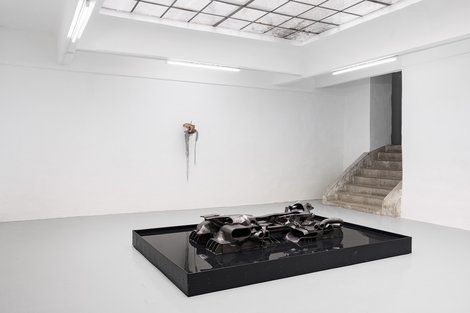
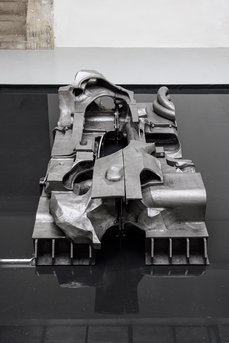
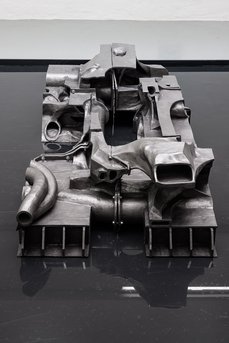
Born in Swindon, once a thriving node of England’s industrial revolution, now occupied with empty and repurposed factories, Sturla thinks of landscape as marked, annotated, obsessively cross-referenced against the real. Following his interest in the impact post-industrial production has on ecological systems, Sturla’s starting point was how to shift the anthropocentric axis through which we view disaster. Fieldnotes (Plant Theatre) turns to the logic he encountered in J.A. Baker’s The Peregrine and the viewer finds themselves looking down onto the work, surveying and circling Sturla’s ceramic forms like a bird reading terrain. Patinated with graphite powder, the part engine, part architecture, part landscape sculpture inhabits sky and earth equally. Set in a shallow pool of water, the surrounding world is reflected back at us and the space above the work is folded into the way it is seen.
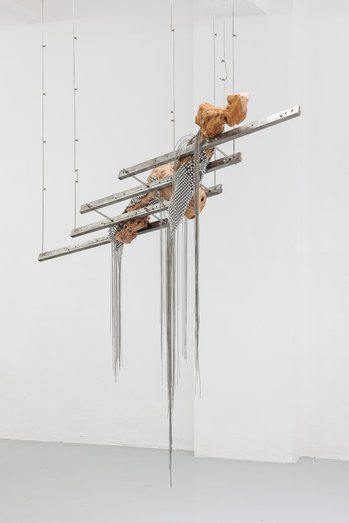
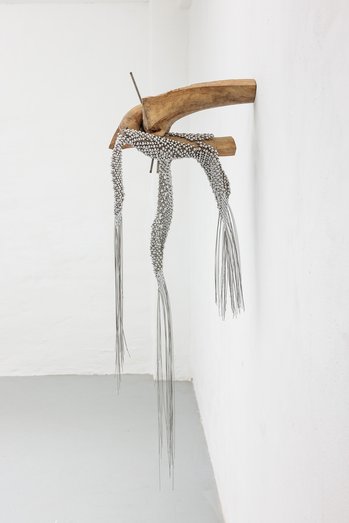
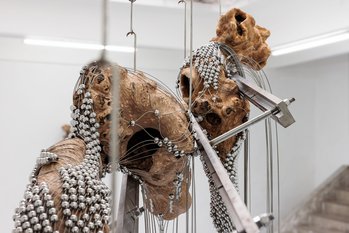
Han approaches the invasion of ecological systems differently, using found pieces of London Plane wood as the bodily nucleus of his series xoxo. Often considered the ultimate city tree, it is widely used in urban planning across continental Europe, thriving in harsh, polluted environments where other species fail. These trees are in fact a product of early globalisation: a botanical intermingling made possible by human trade and transportation. Arriving in Shanghai in 1902 with the French authorities, it became central to the French Concession district and by the 1950s, London Planes accounted for 87% of all street trees in Shanghai. The tree is historically synonymous with a colonial presence in China.
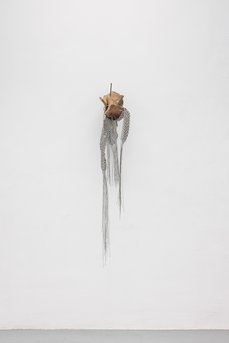
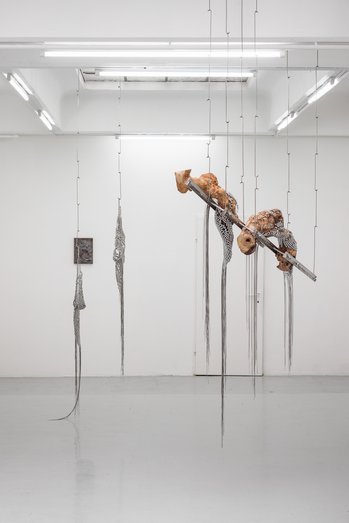
Han traces the shape of the wood with a handwoven net of steel wire with intersections held together by small stainless steel beads. This glistening net follows the natural lines of the wood, mapping its knotted forms like osteotomy. Each work resembles a diagram of its own forces: vectors, pressure and movement extruded into three dimensions. The curvature of the knotted wood and the tension of the steel wire dictate how the suspended works fold in on themselves and reorganise the space around them.
Han traces the shape of the wood with a handwoven net of steel wire with intersections held together by small stainless steel beads. This glistening net follows the natural lines of the wood, mapping its knotted forms like osteotomy. Each work resembles a diagram of its own forces: vectors, pressure and movement extruded into three dimensions. The curvature of the knotted wood and the tension of the steel wire dictate how the suspended works fold in on themselves and reorganise the space around them.
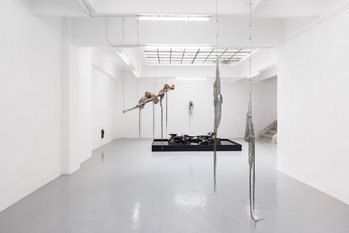
Together, Han and Sturla propose that mapping is never neutral; it carries the weight of what has been extracted, displaced and lost. To understand how we have altered the world, we must first change the axis from which we look at it. The map, they suggest, has always been the first act of possession and to remake it is to ask whether the world can be held without being owned.