Safekeep
Leda Bourgogne
Leda Bourgogne
“She had held a pear in her hand and she had eaten it skin and all. She had eaten the stem and she had eaten its seeds and she had eaten its core, and the hunger still sat in her like an open maw.
She thought: I can hold you and find that I still miss your body.
She thought: I can listen to you speak and still miss the sound of your voice.”
–Yael van der Wouden, The Safekeep
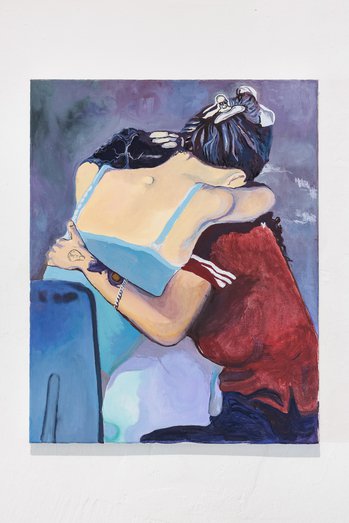
GIANNI MANHATTAN is pleased to present Safekeep, Leda Bourgogne’s first solo exhibition with the gallery. At the core of the exhibition lies the paradox of a sense of safety that fails to deliver on its promise of immaculate protection, and intimacy that requires an ever-evolving process of emotional exposure. Bourgogne’s Safekeep inhabits this space of contradiction where desire, intimacy and safety can co-exist within the ambiguous safety of the home.
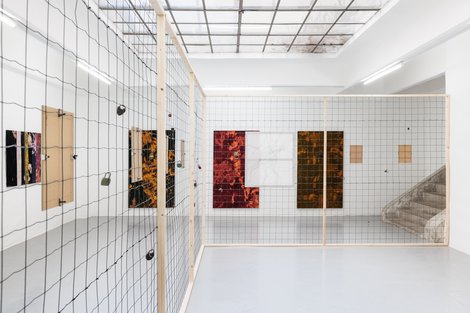
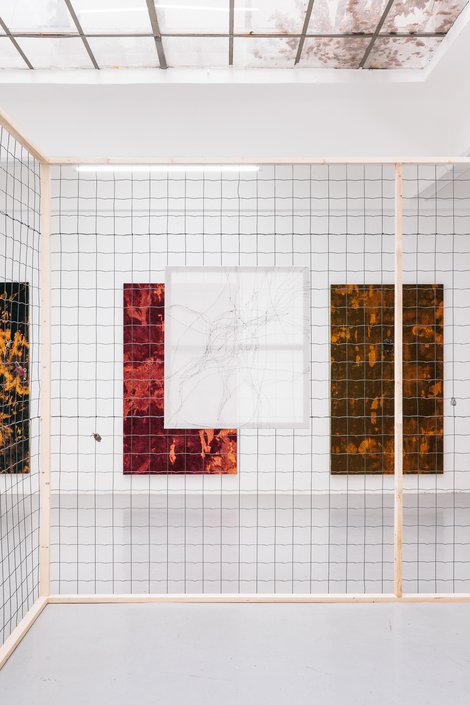
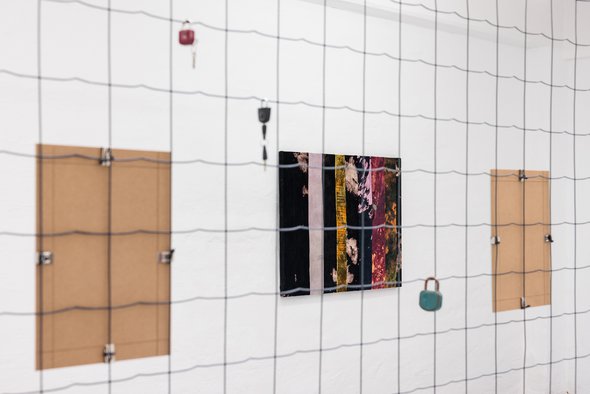
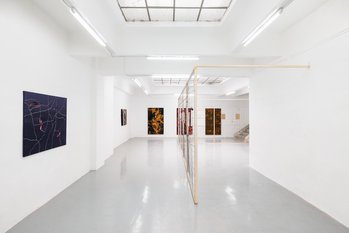
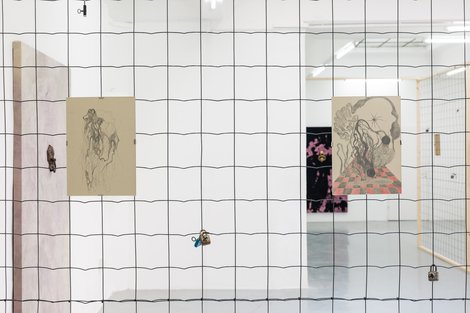
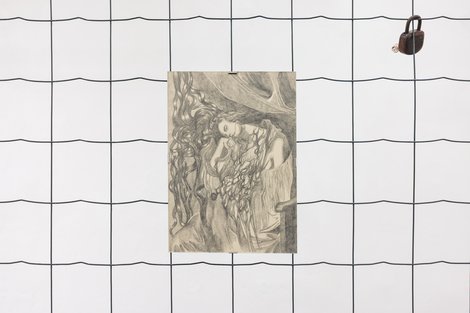
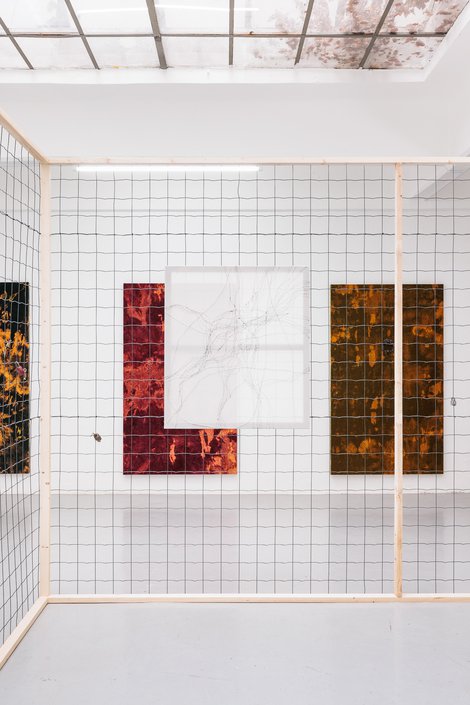
An L-shaped architecture divides the gallery space. This wooden skeleton, clad with metal fencing and expired love-locks defines a zone of proximity: a place where boundaries are continually negotiated. Upon this divide are Bourgogne’s psychoanalytical and subliminal pencil drawings which unfold like neural maps or dream diagrams. They stage the movement from sensation to articulation, charting the entanglement of matter and mind. They suggest that meaning, like intimacy, is something continually becoming and that the image, like thought, must pass through confusion before clarity.
–Yael van der Wouden, The Safekeep
GIANNI MANHATTAN is pleased to present Safekeep, Leda Bourgogne’s first solo exhibition with the gallery. At the core of the exhibition lies the paradox of a sense of safety that fails to deliver on its promise of immaculate protection, and intimacy that requires an ever-evolving process of emotional exposure. Bourgogne’s Safekeep inhabits this space of contradiction where desire, intimacy and safety can co-exist within the ambiguous safety of the home.
An L-shaped architecture divides the gallery space. This wooden skeleton, clad with metal fencing and expired love-locks defines a zone of proximity: a place where boundaries are continually negotiated. Upon this divide are Bourgogne’s psychoanalytical and subliminal pencil drawings which unfold like neural maps or dream diagrams. They stage the movement from sensation to articulation, charting the entanglement of matter and mind. They suggest that meaning, like intimacy, is something continually becoming and that the image, like thought, must pass through confusion before clarity.
6.11.25—20.12.25
GIANNI MANHATTAN, Wassergasse 14, 1030 Vienna
> Installation views
> Artreview Review
“She had held a pear in her hand and she had eaten it skin and all. She had eaten the stem and she had eaten its seeds and she had eaten its core, and the hunger still sat in her like an open maw.
She thought: I can hold you and find that I still miss your body.
She thought: I can listen to you speak and still miss the sound of your voice.”
–Yael van der Wouden, The Safekeep
GIANNI MANHATTAN is pleased to present Safekeep, Leda Bourgogne’s first solo exhibition with the gallery. At the core of the exhibition lies the paradox of a sense of safety that fails to deliver on its promise of immaculate protection, and intimacy that requires an ever-evolving process of emotional exposure. Bourgogne’s Safekeep inhabits this space of contradiction where desire, intimacy and safety can co-exist within the ambiguous safety of the home.
An L-shaped architecture divides the gallery space. This wooden skeleton, clad with metal fencing and expired love-locks defines a zone of proximity: a place where boundaries are continually negotiated. Upon this divide are Bourgogne’s psychoanalytical and subliminal pencil drawings which unfold like neural maps or dream diagrams. They stage the movement from sensation to articulation, charting the entanglement of matter and mind. They suggest that meaning, like intimacy, is something continually becoming and that the image, like thought, must pass through confusion before clarity.
–Yael van der Wouden, The Safekeep
GIANNI MANHATTAN is pleased to present Safekeep, Leda Bourgogne’s first solo exhibition with the gallery. At the core of the exhibition lies the paradox of a sense of safety that fails to deliver on its promise of immaculate protection, and intimacy that requires an ever-evolving process of emotional exposure. Bourgogne’s Safekeep inhabits this space of contradiction where desire, intimacy and safety can co-exist within the ambiguous safety of the home.
An L-shaped architecture divides the gallery space. This wooden skeleton, clad with metal fencing and expired love-locks defines a zone of proximity: a place where boundaries are continually negotiated. Upon this divide are Bourgogne’s psychoanalytical and subliminal pencil drawings which unfold like neural maps or dream diagrams. They stage the movement from sensation to articulation, charting the entanglement of matter and mind. They suggest that meaning, like intimacy, is something continually becoming and that the image, like thought, must pass through confusion before clarity.
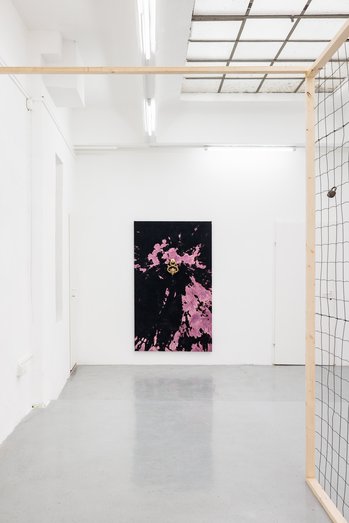
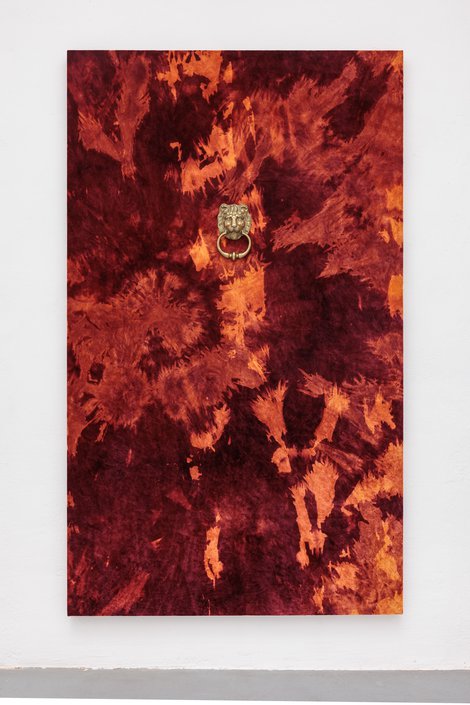
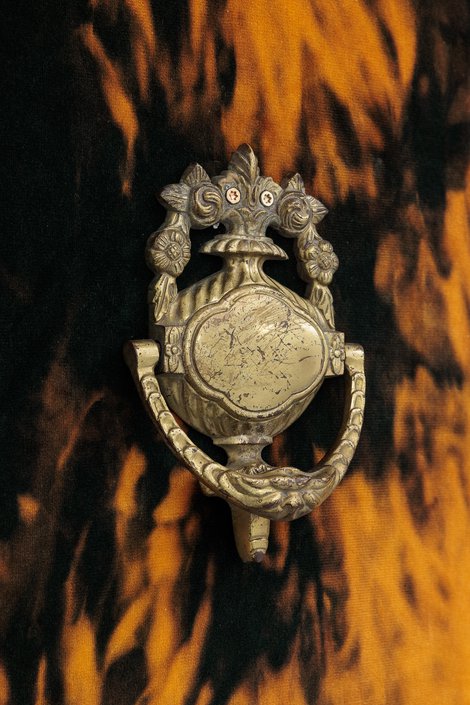
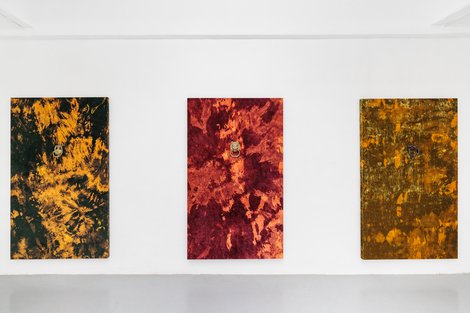
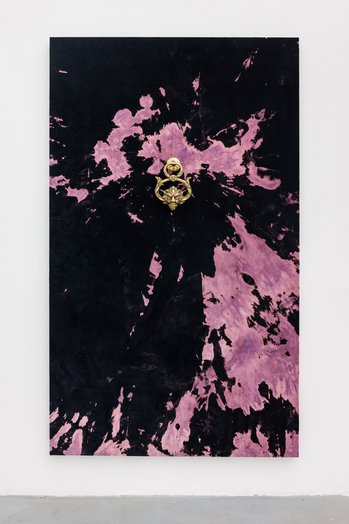
The proportions of a door recur throughout the exhibition. The new series, ‘Safeguard’ are dysfunctional architectures, clad in velvet and fitted with bronze door knockers, that depict a threshold between self and other, interior and exterior. In this sense, Bourgogne’s doorways are not about entry but reflect on negotiation. They recall the ego boundary in psychoanalytic theory, a fragile perimeter where the self defines and defends itself.
Historically, velvet carries the weight of privilege and hierarchy. Royal purple and crimson of aristocratic interiors are tactile signifiers of wealth and possession. Bourgogne enacts a gesture of unmaking by bleaching these fabrics. The saturated decadence is drained to pallor and what remains is a ghostly, scarred material that has survived its own undoing. Vulnerable, exposed but still insistently present, this gesture reads as a feminist dismantling of inherited hierarchies and carries a persistent and embodied form of resistance.
Bourgogne often works at this periphery of articulation where symbols, gestures and sounds start to form meaning. In Safekeep, this nascent language is tender and unruly and moves between the body, the domestic and the psychic. What emerges is a state of porous attention, an awareness that safety and exposure, silence and speech, are never opposites but interdependent conditions. In this oscillation, Bourgogne locates a politics of vulnerability that offers a form of safeguarding by allowing things to breathe, leak and transform rather than enclose.
Historically, velvet carries the weight of privilege and hierarchy. Royal purple and crimson of aristocratic interiors are tactile signifiers of wealth and possession. Bourgogne enacts a gesture of unmaking by bleaching these fabrics. The saturated decadence is drained to pallor and what remains is a ghostly, scarred material that has survived its own undoing. Vulnerable, exposed but still insistently present, this gesture reads as a feminist dismantling of inherited hierarchies and carries a persistent and embodied form of resistance.
Bourgogne often works at this periphery of articulation where symbols, gestures and sounds start to form meaning. In Safekeep, this nascent language is tender and unruly and moves between the body, the domestic and the psychic. What emerges is a state of porous attention, an awareness that safety and exposure, silence and speech, are never opposites but interdependent conditions. In this oscillation, Bourgogne locates a politics of vulnerability that offers a form of safeguarding by allowing things to breathe, leak and transform rather than enclose.