Writ in Water
Anu Põder
Anu Põder
GIANNI MANHATTAN is pleased to present an exhibition of works by Anu Põder (b. 1947, Kanepi, Estonia, † 2013, Tallinn, Estonia).
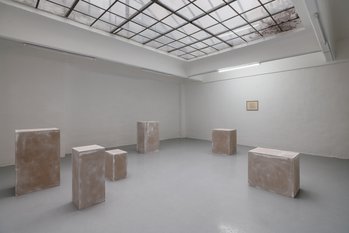
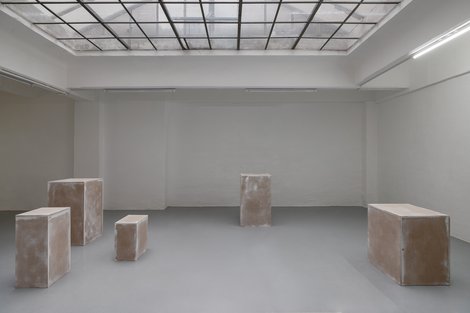
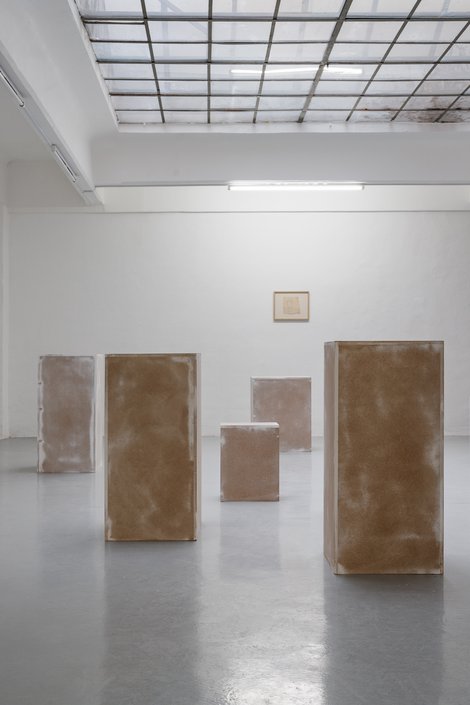
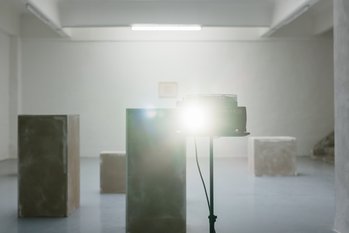
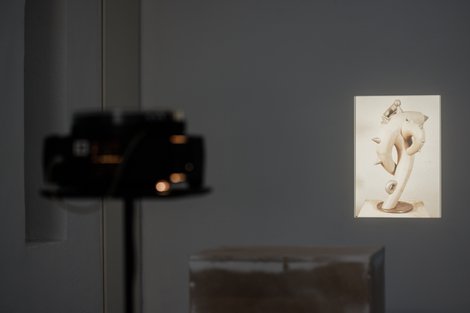
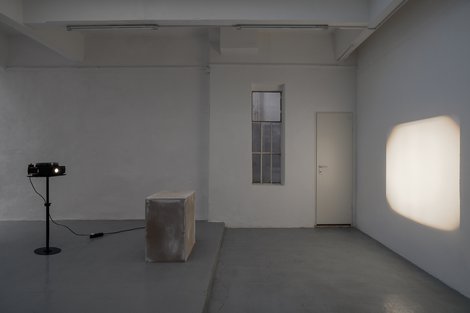
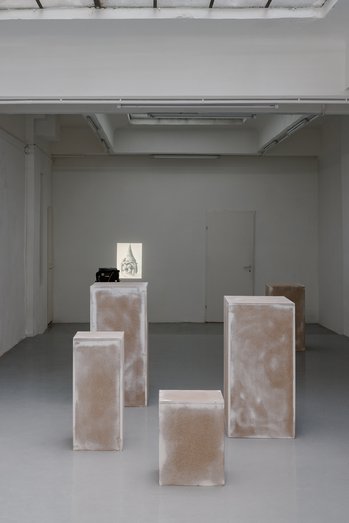
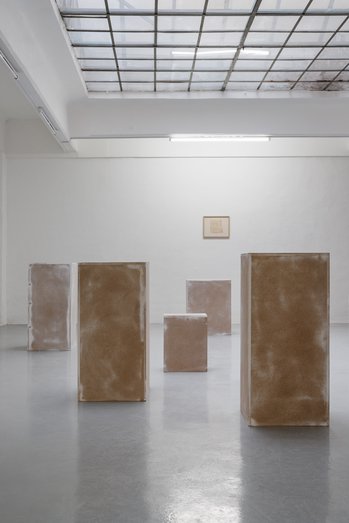
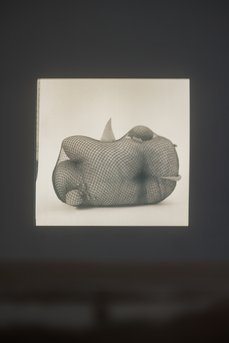
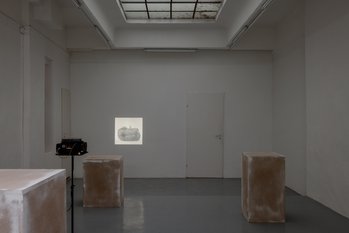
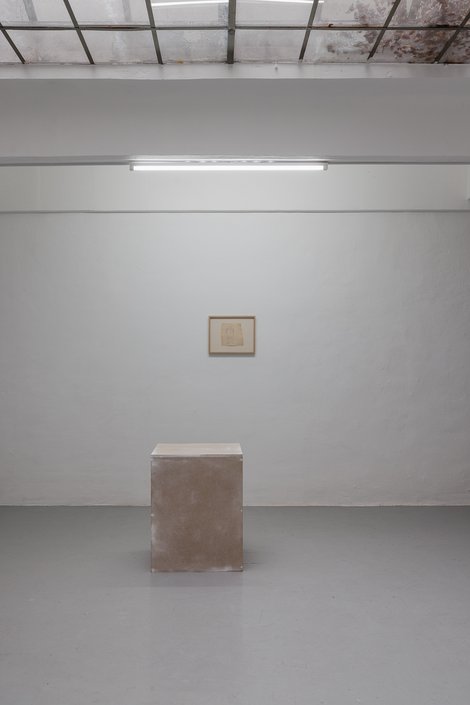
“Writ in Water” is dedicated to the archive of Anu Põder and to the fragile afterlives of artworks shaped by their disappearance. The exhibition reconstructs nine works through plinths built to their original external dimensions, which stand as spatial proxies, while a slide projector casts archival images of Põder’s lost sculptures onto the wall. A solitary drawing for an unrealised work extends this gesture, framing loss not as a void but as a material condition of Põder’s practice.
At the centre of the presentation lies the proposition that sculpture can be understood as something away from permanence and is conditioned by its exposure to time. What remains of the lost artworks is neither a substitute or secondary to their presence, but instead their traces become the work’s current form and their present tense.
Across her practice, Põder employed unstable materials such as soap, textiles and beeswax, allowing transformation and eventual disappearance to enter her logic of form. Throughout her lifetime the camera and her drawings recorded her artworks but also extended them. The remaining documentation carries forward a vocabulary of touch, fragility and psychic charge, preserving situations and constellations that can never be fully replicated.
“Writ in Water” is dedicated to the archive of Anu Põder and to the fragile afterlives of artworks shaped by their disappearance. The exhibition reconstructs nine works through plinths built to their original external dimensions, which stand as spatial proxies, while a slide projector casts archival images of Põder’s lost sculptures onto the wall. A solitary drawing for an unrealised work extends this gesture, framing loss not as a void but as a material condition of Põder’s practice.
At the centre of the presentation lies the proposition that sculpture can be understood as something away from permanence and is conditioned by its exposure to time. What remains of the lost artworks is neither a substitute or secondary to their presence, but instead their traces become the work’s current form and their present tense.
Across her practice, Põder employed unstable materials such as soap, textiles and beeswax, allowing transformation and eventual disappearance to enter her logic of form. Throughout her lifetime the camera and her drawings recorded her artworks but also extended them. The remaining documentation carries forward a vocabulary of touch, fragility and psychic charge, preserving situations and constellations that can never be fully replicated.
12.02.26—21.03.26
GIANNI MANHATTAN, Wassergasse 14, 1030 Vienna
> Installation views
GIANNI MANHATTAN is pleased to present an exhibition of works by Anu Põder (b. 1947, Kanepi, Estonia, † 2013, Tallinn, Estonia).
“Writ in Water” is dedicated to the archive of Anu Põder and to the fragile afterlives of artworks shaped by their disappearance. The exhibition reconstructs nine works through plinths built to their original external dimensions, which stand as spatial proxies, while a slide projector casts archival images of Põder’s lost sculptures onto the wall. A solitary drawing for an unrealised work extends this gesture, framing loss not as a void but as a material condition of Põder’s practice.
At the centre of the presentation lies the proposition that sculpture can be understood as something away from permanence and is conditioned by its exposure to time. What remains of the lost artworks is neither a substitute or secondary to their presence, but instead their traces become the work’s current form and their present tense.
Across her practice, Põder employed unstable materials such as soap, textiles and beeswax, allowing transformation and eventual disappearance to enter her logic of form. Throughout her lifetime the camera and her drawings recorded her artworks but also extended them. The remaining documentation carries forward a vocabulary of touch, fragility and psychic charge, preserving situations and constellations that can never be fully replicated.
“Writ in Water” is dedicated to the archive of Anu Põder and to the fragile afterlives of artworks shaped by their disappearance. The exhibition reconstructs nine works through plinths built to their original external dimensions, which stand as spatial proxies, while a slide projector casts archival images of Põder’s lost sculptures onto the wall. A solitary drawing for an unrealised work extends this gesture, framing loss not as a void but as a material condition of Põder’s practice.
At the centre of the presentation lies the proposition that sculpture can be understood as something away from permanence and is conditioned by its exposure to time. What remains of the lost artworks is neither a substitute or secondary to their presence, but instead their traces become the work’s current form and their present tense.
Across her practice, Põder employed unstable materials such as soap, textiles and beeswax, allowing transformation and eventual disappearance to enter her logic of form. Throughout her lifetime the camera and her drawings recorded her artworks but also extended them. The remaining documentation carries forward a vocabulary of touch, fragility and psychic charge, preserving situations and constellations that can never be fully replicated.
If loss is understood as absence or something physically missing, here it becomes generative. The lost object asks how an artwork can continue when its material substance is gone. In this oscillation between disappearance and survival, Põder proposes another durability—one held in transmission, in repetition and in the stubborn life of images.
Installed in the gallery, Põder’s photographs and studies operate as activations of the lost artworks. They stage a continual movement between what has been and what can still be imagined. In this instance documentation of her Estate becomes a threshold through which sculpture passes from material fact into memory, and from memory back into encounter.
Installed in the gallery, Põder’s photographs and studies operate as activations of the lost artworks. They stage a continual movement between what has been and what can still be imagined. In this instance documentation of her Estate becomes a threshold through which sculpture passes from material fact into memory, and from memory back into encounter.